
Photo source: Glen Bowman from Newcastle, England, CC BY 2.0, via Wikimedia Commons
About this place
Cragside stands above the town of Rothbury in Northumberland, built as a country retreat for William Armstrong, the Victorian engineer and arms manufacturer.
It holds the distinction of being the first house in the world lit by hydroelectric power, generated from lakes and dams Armstrong built across the estate.
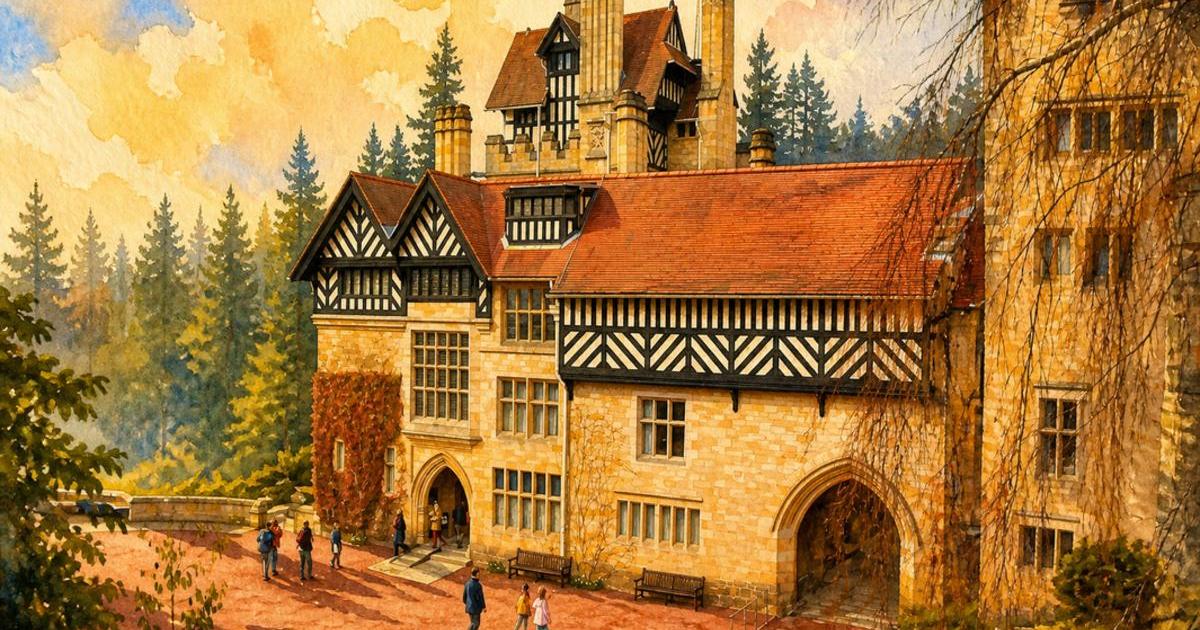
The architect Richard Norman Shaw transformed an original shooting lodge into a turreted Tudor Revival mansion between 1869 and 1882.
The National Trust has cared for Cragside since 1977, and the grounds still contain the machinery Armstrong used to power his inventions.
Read more on WikipediaHistory
Armstrong acquired a small shooting lodge on the site between 1862 and 1864, then employed Richard Norman Shaw from 1869 to enlarge it into the dramatic house seen today. In 1887 he became Baron Armstrong of Cragside, the first engineer or scientist to receive a peerage. He and his wife assembled a significant collection of 19th-century British art, much of which remains in the house.
Architecture
Richard Norman Shaw designed the house in the Tudor Revival style, working in two main phases between 1869 and 1882 to turn a modest lodge into a turreted, asymmetrical mansion.
Worth knowing
William Armstrong invented the hydraulic crane and the Armstrong gun, and used the same engineering ingenuity at home, powering a water-driven laundry, dishwasher, dumb waiter and rotisserie from dams built in the grounds.
Gardens & grounds
The estate's man-made lakes and extensive planting, laid out largely to serve Armstrong's hydraulic schemes, now form a significant rock garden and wooded landscape open to visitors.
Facilities
Plan your visit
Nearest station: Acklington Rail Station (9.2 miles)
Nearby properties
Brinkburn Priory
View Brinkburn Priory on heritage mapEdlingham Castle
View Edlingham Castle on heritage mapWarkworth Hermitage
View Warkworth Hermitage on heritage mapHistoric places nearby
Within 5 miles of Cragside (NE65) there are 2 historic properties, including 1 historic building and 1 historic house, across English Heritage and Historic Houses sites.
Within 10 miles of Cragside (NE65) there are 4 historic properties, including 2 castles, across English Heritage and Historic Houses sites.
Within 20 miles of Cragside (NE65) there are 13 historic properties, including 6 castles, 4 historic buildings and 3 historic houses, across English Heritage, Historic Houses and National Trust sites.
Facts
The Victorian house that beat the world to hydroelectric lighting, powered by its own lakes and dams.
- Type
- historic building
- Location
- Northumberland, England
Featured in Hidden Britain
 Issue 15— August 2026
Get Hidden Britain
A free weekly newsletter on Britain's overlooked historic places.