
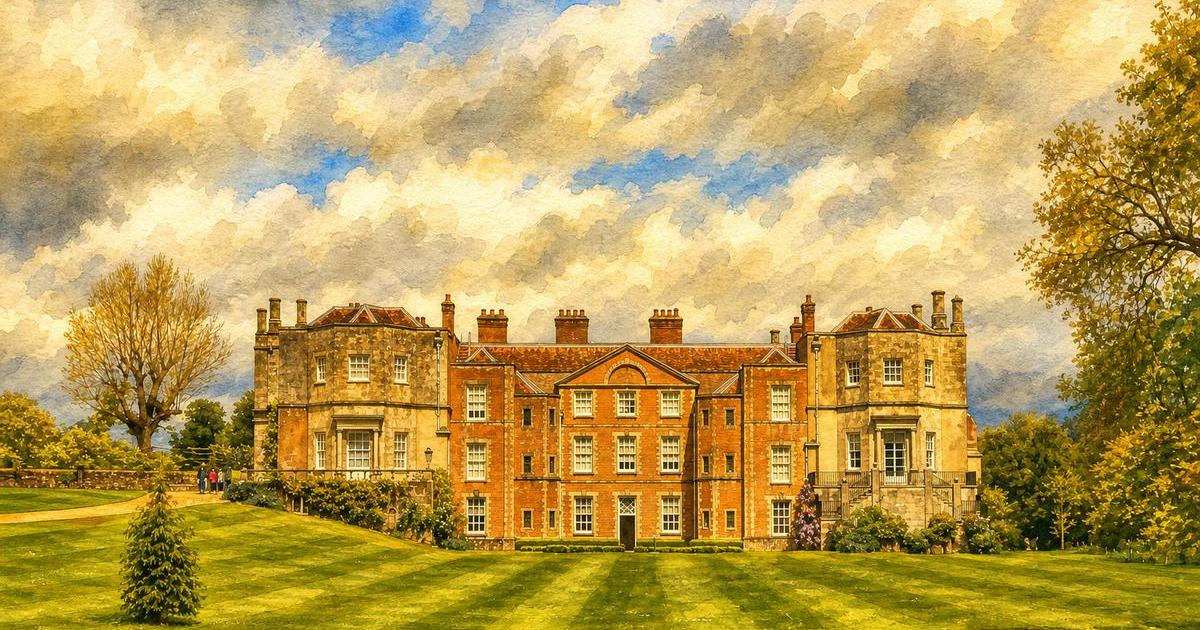
Photo: Kate Jewell / Wikimedia Commons (CC BY-SA 2.0)
Mottisfont Abbey is a Grade I listed historic building in Hampshire, cared for by the National Trust. Read about its history, architecture and gardens, plus how to visit and what's nearby.
About Mottisfont Abbey
Mottisfont Abbey in Hampshire grew from an Augustinian priory founded in 1201, and that long layering of use across centuries gives the place its unusual character.
After the Dissolution of the Monasteries the priory passed into private hands and was converted into a country house, with the medieval fabric absorbed into the domestic structure.
The National Trust now manages the property and the surrounding estate.
Inside, Rex Whistler's trompe l'oeil mural in the drawing room, painted in the 1930s, is one of the most admired examples of his decorative work.
The walled rose garden holds a nationally significant collection of old-fashioned and species roses, considered one of the finest in the country.
Read more on WikipediaHistory of Mottisfont Abbey
The property began as an Augustinian priory founded in 1201. After the Dissolution of the Monasteries it passed into private hands and was converted into a country house, with the priory fabric absorbed into the domestic structure. The National Trust took on the property in the twentieth century.
Architecture of Mottisfont Abbey
The building reflects its layered past, with medieval priory fabric incorporated into what became a country house over successive centuries. Elements of the original monastic structure remain visible within the later domestic building.
Worth knowing
Artist Rex Whistler painted a celebrated trompe l'oeil mural in the drawing room during the 1930s, and it remains one of the most admired examples of his decorative work.
Gardens & grounds at Mottisfont Abbey
The walled garden holds a nationally significant collection of old-fashioned and species roses, at its peak in early summer.
Facilities
Plan your visit to Mottisfont Abbey
Nearest station: Mottisfont & Dunbridge Rail Station (0.7 miles)
Open year-round with seasonal variation; check the National Trust website for current opening days and times.
Places to visit near Mottisfont Abbey
Church of St John the Baptist, Upper Eldon
View Church of St John the Baptist, Upper Eldon on heritage mapHoughton Lodge
View Houghton Lodge on heritage mapSt Mary's Church, Ashley
View St Mary's Church, Ashley on heritage mapAll Saints Church, Little Somborne
View All Saints Church, Little Somborne on heritage mapThe Pepperbox
View The Pepperbox on heritage mapHistoric places nearby
Within 5 miles of Mottisfont Abbey (SO51) there are 4 historic properties, including 3 churchs, across Churches Conservation Trust and Historic Houses sites.
Within 10 miles of Mottisfont Abbey (SO51) there are 8 historic properties, including 3 historic buildings and 3 churchs, across Churches Conservation Trust, English Heritage and National Trust sites.
Within 20 miles of Mottisfont Abbey (SO51) there are 35 historic properties, including 13 historic buildings, 7 churchs and 6 historic houses, across English Heritage, Churches Conservation Trust and Historic Houses sites.
Facts
A medieval priory converted into a country house, with a Rex Whistler mural and one of Britain's foremost rose collections.
- Type
- historic building
- Location
- Hampshire, England
- Visit duration
- Allow 2-3 hours
Featured in Hidden Britain
More stories like this, every week
Get Hidden Britain, our free weekly letter from Rob and Ali. Remarkable historic places, the stories behind them, and ideas for your next day out.
Read the latest letter first →