
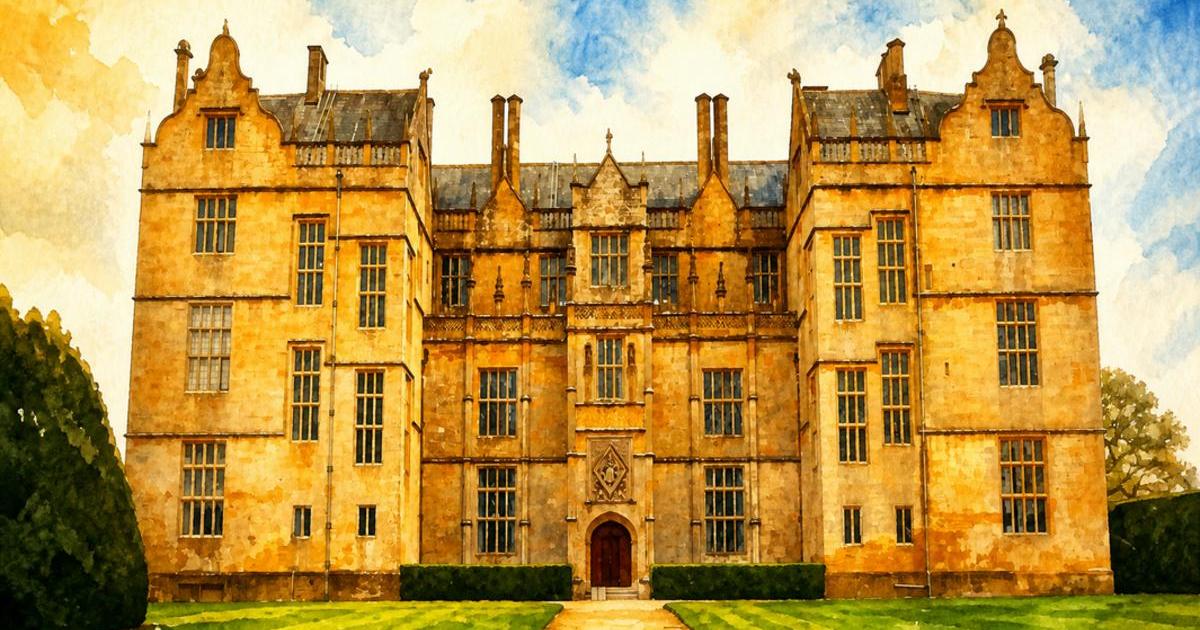
Photo: Tilman2007 / Wikimedia Commons (CC BY-SA 4.0)
Montacute House is a Grade I listed historic building in Somerset, cared for by the National Trust. Read about its history and architecture, plus how to visit and what's nearby.
About Montacute House
Montacute House was built around 1598 for Sir Edward Phelips, a lawyer who became Speaker of the House of Commons and later Master of the Rolls.
The mansion stands in Montacute, Somerset, built from local Ham Hill stone that gives it a distinctive golden colour.
It is one of the few great Elizabethan prodigy houses to survive largely unchanged, and both the house and its gardens carry the highest heritage listing grade in England.
The National Trust acquired the property in 1927.
Read more on WikipediaHistory of Montacute House
Sir Edward Phelips, who became Speaker of the House of Commons and later Master of the Rolls, commissioned the house around 1598. He went on to prosecute the Gunpowder Plotters. His descendants occupied the property until the early twentieth century. The National Trust acquired Montacute House in 1927.
Architecture of Montacute House
The three-storey mansion is thought to have been designed by mason William Arnold, marking the transition from Gothic to Renaissance-influenced English building design.
Facilities
Plan your visit to Montacute House
Nearest station: Yeovil Pen Mill Rail Station (4.4 miles)
Places to visit near Montacute House
Stoke sub Hamdon Priory
View Stoke sub Hamdon Priory on heritage mapTintinhull House
View Tintinhull House on heritage mapTreasurer's House
View Treasurer's House on heritage mapLytes Cary
View Lytes Cary on heritage mapHistoric places nearby
Within 5 miles of Montacute House (TA15) there are 3 historic properties, including 3 historic buildings.
Within 10 miles of Montacute House (TA15) there are 9 historic properties, including 7 historic buildings, across National Trust and English Heritage sites.
Within 20 miles of Montacute House (TA15) there are 32 historic properties, including 17 historic buildings, 6 historic houses and 3 archaeological sites, across National Trust, English Heritage and Historic Houses sites.
Facts
An Elizabethan prodigy house that survived to become a major property under National Trust stewardship.
- Type
- historic building
- Location
- Somerset, England
Featured in Hidden Britain
 Issue 21— September 2026
Get Hidden Britain
A free weekly newsletter on Britain's overlooked historic places.